Writing Code in the Age of AI — Is Reading Code Still Worth It?
Something has changed about the way we write software.
A few years ago, building a feature meant opening an editor, writing code, reading documentation, debugging errors, and slowly figuring things out.
Today, I can describe a feature to Claude, open Cursor, or use Antigravity, and watch an AI agent write code, modify files, run commands, and build things that would have taken hours to implement manually.
The feedback loop has changed dramatically.
Writing code is becoming cheaper. Faster. Almost effortless in some cases.
But it leaves me with a question:
If AI writes the code, do we still need to read it?
Nobody wants to read code anymore
Let’s be honest. Most developers never enjoyed reading large amounts of unfamiliar code in the first place.
We read code because we had to. To understand an existing system, find a bug, add a feature, or figure out why something wasn’t working.
Now, AI can do a lot of that work for us.
Instead of searching through ten files, I can ask an AI agent to trace the flow. Instead of manually implementing a change, I can describe the expected behavior. Instead of spending an hour understanding an unfamiliar API, I can ask for an explanation.
And often, it works surprisingly well.
So why spend thirty minutes reading code when an AI can explain it in thirty seconds?
Maybe the problem isn’t that we don’t want to read code anymore.
Maybe we have found a faster way to get answers.
The dangerous part is that working code looks like correct code
Here is where things get interesting.
AI can generate code that compiles, passes existing tests, and appears to do exactly what we asked.
But working code and correct code are not always the same thing.
What happens when the implementation handles the happy path but misses an edge case? When a seemingly harmless abstraction introduces complexity? When a database query works in development but fails under production load?
What happens when the code introduces a security issue that isn’t covered by the tests?
The application may work today. The problem might appear three months later, when somebody changes a seemingly unrelated feature.
And if we never understood the original implementation, debugging becomes a different kind of problem.
We are no longer just debugging code.
We are debugging code we delegated to a system whose decisions we may not fully understand.
That is a very different responsibility.
Reading every line is probably not the answer
I don’t think the solution is to manually inspect every line AI generates.
That would defeat much of the purpose of using these tools.
If an AI agent creates a straightforward component, generates a routine test, or performs a predictable refactoring, reviewing every character may not be the best use of a developer’s time.
The more interesting question is: What do we need to understand before we trust the result?
Maybe we need to focus less on reading every line and more on understanding the decisions behind those lines.
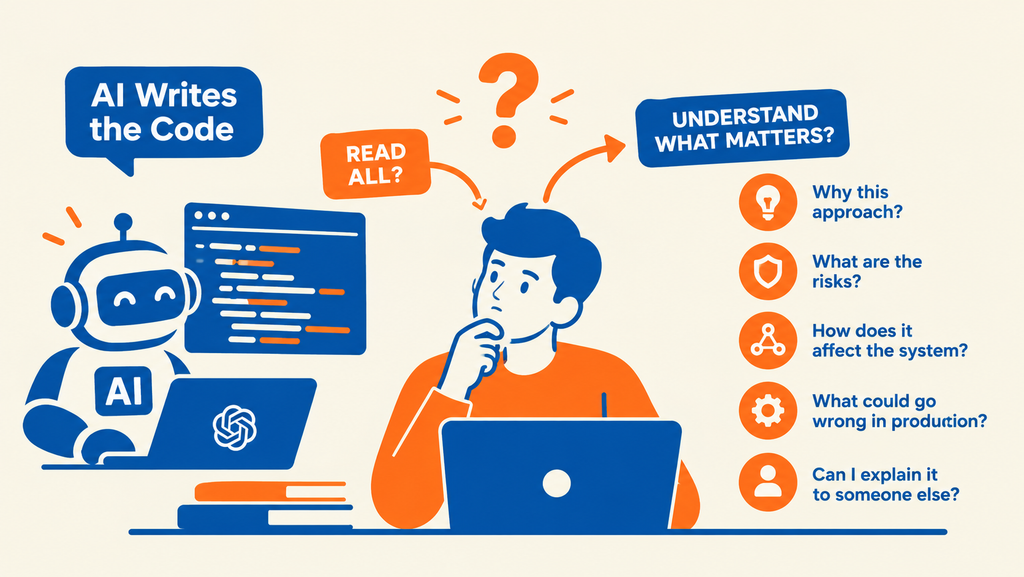
- Why was this approach chosen?
- What assumptions does the implementation make?
- What happens when the input is invalid?
- How does this change affect the rest of the system?
- What could go wrong in production?
- Can I explain this implementation to another engineer?
We don’t necessarily need to write every line ourselves.
But we should know what we are shipping.
The developer’s job is changing
When writing code was expensive, a significant part of a developer’s value came from the ability to implement things correctly and efficiently.
AI is changing that equation.
If anyone can generate a working prototype in minutes, the advantage shifts toward knowing what should be built, choosing the right architecture, recognizing flawed solutions, and understanding the consequences of technical decisions.
The bottleneck moves from producing code to exercising judgment.
And judgment requires understanding.
You cannot reliably identify a bad abstraction if you don’t understand the problem. You cannot make a meaningful architectural trade-off if you don’t understand the constraints. And you cannot confidently maintain a system if your only mental model is that an AI agent built it and the tests passed.
In this world, reading code may become less about understanding every implementation detail and more about developing the confidence to challenge what the AI produces.
So, is reading code still worth it?
Yes. But perhaps not in the way it used to be.
We may read less code line by line. We may rely more on AI to explain unfamiliar systems, trace dependencies, and identify potential problems.
That is progress.
But delegating implementation does not mean delegating responsibility.
The more code we generate, the more important it becomes to know which parts deserve our attention. The faster we ship, the more deliberate we must be about verification.
I don’t think the future belongs to developers who refuse to use AI and insist on doing everything manually.
Nor do I think it belongs to developers who blindly accept everything AI generates.
It belongs to developers who know when to delegate, when to inspect, when to question, and when not to trust the result.
Maybe the real skill in the age of AI isn’t writing code or even reading all of it. It’s knowing what you need to understand before you ship it.
And that is a skill worth keeping.


